
How to use DE for gnats: Apply food-grade diatomaceous earth (amorphous silica) to dry topsoil to kill fungus gnat larvae. The powder desiccates larvae by absorbing moisture and abrading their exoskeletons. Reapply after watering. Results visible within 48-72 hours.
⚠️ WARNING: Wear a mask during application. Fine silica dust irritates lungs.
Table of Contents
Introduction: The Tiny Terror in Your Soil
Let’s be honest. You’re here because you’re losing your mind.
Are those tiny black flies hovering around your Ficus Shivereana? They’re not just annoying—they’re a symptom of a bigger problem happening beneath the soil surface. Fungus gnats (Sciaridae) have invaded your indoor garden, and no amount of swatting is solving it.
Here’s the brutal truth most articles won’t tell you: the adults aren’t your real enemy. Those flying nuisances live only about a week. The real destruction happens underground, where fungus gnat larvae are actively feeding on your plant’s roots and organic matter, causing root damage, stunted growth, and slow plant death.
This is where diatomaceous earth enters the conversation—a naturally occurring powder made from fossilised diatoms (microscopic algae) that’s been used in organic pest management for decades. But here’s the catch: most guides oversimplify it. They don’t tell you about the safety nuances, the critical difference between product grades, or why your application method matters more than the product itself.
I’m going to fix that.
If you’ve ever seen tiny black flies clouding around your favorite houseplant, you know the instant ‘gnat rage’ it causes. You’ve tried the yellow sticky traps, but the swarm keeps coming back. Enter Diatomaceous Earth (DE)—the microscopic ‘razor wire’ of the organic plant world.
But does diatomaceous earth actually kill fungus gnats, or is it just a messy myth? In this Urban Lab guide, we’re looking at the science of silica, the ‘Bottom-Watering’ trick, and the exact protocol to wipe out a gnat infestation without using harsh chemicals.
Note: Diatomaceous Earth only works on dry soil. If you have pests on the leaves (like Spider Mites), you need to apply a Neem Oil emulsion instead.
The Science: Why It Kills Larvae (But Not Adults)
Understanding why diatomaceous earth works is essential to using it correctly. This isn’t magic—it’s mechanical pest control at the microscopic level.
The Dual-Action Kill Mechanism
Food-grade diatomaceous earth, composed primarily of amorphous silica, destroys fungus gnat larvae through two simultaneous processes:
1. Desiccation The ultra-fine particles of DE are highly absorbent. When larvae come into contact with the powder, it rapidly pulls moisture from their bodies. Insects—especially soft-bodied larvae—cannot survive this level of dehydration. Their internal fluids are literally absorbed by the silica particles.
2. Exoskeleton Abrasion Under a microscope, diatomaceous earth particles have razor-sharp edges. These edges physically lacerate the protective outer layer (exoskeleton) of insects. Once the exoskeleton is compromised, moisture loss accelerates dramatically, and death occurs within 24–48 hours.
💡 The #1 Reason DE Fails: Diatomaceous Earth is only effective when it is 100% dry. If you apply it to damp soil, the microscopic “razors” become clogged with water and lose their ability to pierce the insects. Always let your topsoil dry out completely before applying!
Why Adults Escape
Here’s the limitation: adult fungus gnats spend most of their time flying, not crawling through treated soil. The larvae, however, live their entire developmental stage burrowed in moist topsoil—exactly where you’ll apply the DE. This is why diatomaceous earth is a larva-targeting solution, not an adult-killing one.
To break the fungus gnat lifecycle completely, you need to eliminate larvae before they pupate and emerge as egg-laying adults. DE does exactly that—if applied correctly.
“Does Diatomaceous Earth kill fungus gnats? Yes, but only when it is 100% dry. Diatomaceous Earth (DE) works by physically shredding the exoskeletons of gnat larvae and adults on contact. However, it does not kill the eggs, which is why a 3-week application protocol is required to break the lifecycle.”
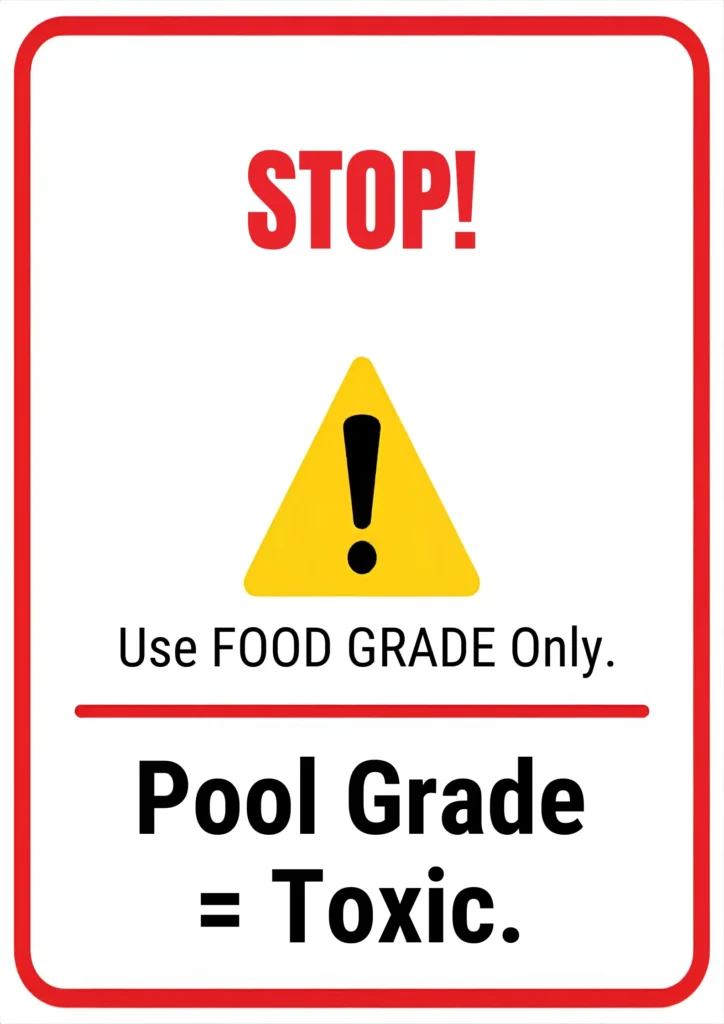
CRITICAL WARNING: Food Grade vs. Pool Grade
Read this section carefully. Your safety—and your pets’ safety—depends on it.
Not all diatomaceous earth is the same. There are two primary types, and using the wrong one can cause serious, irreversible health damage.
Food-Grade Diatomaceous Earth (SAFE for Pest Control)
- Composition: Primarily amorphous silica (non-crystalline structure)
- Safety Profile: Generally recognised as safe for humans and animals when used as directed.
- Inhalation risk: Low in small exposures, but prolonged inhalation can still irritate respiratory pathways
- Ingestion: Safe in small amounts—it’s actually used in some food products and pet supplements.
This is the ONLY type you should use for fungus gnat control.
For a deeper technical breakdown of how silicon dioxide affects insects vs. mammals, you can review the General Fact Sheet from the National Pesticide Information Center .
Pool/Filter-Grade Diatomaceous Earth (DANGEROUS)
- Composition: Contains high concentrations of crystalline silica
- Safety profile: Toxic. It is classified as a carcinogen with prolonged exposure.
- Inhalation risk: Severe. Crystalline silica causes silicosis—a progressive, incurable lung disease. It can also lead to lung cancer.
- Ingestion: Unsafe. Never use pool-grade DE around food, pets, or in living spaces.
Pool-grade DE is chemically treated for filtration efficiency and is NEVER appropriate for pest management. If your product doesn’t explicitly say “food grade” on the label, do not use it indoors.
The Urban Lab Application Guide (Step-by-Step)
Here’s where most guides fail you. Most guides simply recommend “Sprinkling it on the soil” and then leave it there. In reality, application conditions determine success or failure.
The Urban Reality
If you live in a small apartment—and statistically, most indoor plant enthusiasts do—you need to understand something: fine dust lingers. In a 500-square-foot studio, airborne silica particles from a casual application can remain suspended for hours, settling on surfaces, furniture, and into your HVAC system.
This doesn’t mean you can’t use DE. It means you need to be strategic.
Step 1: Dry the Soil (This Is Non-Negotiable)
Diatomaceous earth only works when dry.
Once wetted, DE clumps together and loses both its abrasive properties and its hydrophobic desiccating action. The sharp edges become rounded, and the powder essentially becomes inert mud.
Before application:
- Allow soil to dry out completely—at least the top 1-2 inches.
- Wait 3-5 days after your last watering (depending on plant type and humidity).
- Test soil with your finger: it should feel dusty, not cool or moist.
This step also weakens larvae, as they thrive in moisture. A dry environment stresses them before DE even makes contact.
Step 2: Mask Up & Isolate pets.
This is the safety-first moment. Do not skip it.
Even food-grade amorphous silica irritates lung tissue when inhaled. For a one-time application in a well-ventilated area, this risk is minimal for healthy adults. But cumulative exposure matters, and your pets are more vulnerable than you are.
Required precautions:
- Wear an N95 respirator or dust mask rated for fine particles.
- Move pets to another room and close the door.
- If possible, open a window or run an exhaust fan.
- Keep children out of the room during application.
The Pet Safety Truth: Food-grade DE is non-toxic to pets if eaten—many pet owners actually add it to food as a dewormer. However, the dust can be harmful to their lungs. Cats and dogs have smaller respiratory systems and are closer to the ground where dust settles. Isolate pets during application and for at least 2 hours afterward while particles settle.
Step 3: The “Dusting” Technique
Method matters more than quantity.
You don’t need to bury your soil in white powder. A light, even coating across the topsoil surface is far more effective than heavy dumping—and creates less airborne dust.
Application technique:
- Use a small sifter, flour duster, or even a sock filled with DE.
- Hold 6-8 inches above the soil surface.
- Apply a thin, visible layer across the entire topsoil—you should still see soil colour through the powder.
- Gently work a small amount into the top ¼ inch of soil with a fork (optional, but increases larvae contact).
- Avoid application on plant stems or leaves—it won’t harm them, but it’s unnecessary and creates more airborne dust.
For extreme urban caution: Some indoor gardeners prefer a “wet application” method—mixing DE with water to create a slurry, painting it on soil, and letting it dry. This eliminates airborne dust during application entirely. The trade-off: it takes 24-48 hours to dry and become effective, and you’ll need to reapply once it fully dries.
Is It Truly Pet Safe? (The Nuanced Verdict)
This section is where I have to be brutally honest, because most articles give you a simple “yes” or “no” when the reality is more complicated.
The Verdict: Conditional Yes
Ingestion: generally safe. If your cat walks through treated soil and licks their paws, or your dog noses around a treated pot, the small amount of food-grade amorphous silica they ingest is not toxic. DE is actually used in agricultural feed and some pet supplements. The compound passes through the digestive system without being absorbed.
Inhalation = No. Absolutely Not. The same fine particles that kill larvae through desiccation will irritate mammalian lung tissue. While a single exposure is unlikely to cause permanent damage in a healthy adult pet, repeated exposure or exposure in pets with existing respiratory conditions (brachycephalic breeds, older cats, animals with asthma) can cause real harm.
The Urban Lab Recommendation: Use diatomaceous earth for fungus gnats with pets in another room during application. Allow 2+ hours for dust to settle. Lightly mist the treated soil surface with water after settling is complete—this locks particles in place and prevents future dust-ups when pets investigate. Yes, this slightly reduces efficacy, but it’s the responsible balance between pest management and pet safety.
Frequently Asked Questions
“Can I water on top of diatomaceous earth?”
No—this defeats the purpose.
Water destroys the mechanical properties that make DE effective. Once saturated, the sharp-edged particles clump together and lose their ability to abrade exoskeletons or absorb moisture from larvae. You’ll need to reapply after every watering.
Pro tip: Water from the bottom (place a pot in a tray of water and let soil wick upward) to keep the top layer of DE dry longer.
“Does diatomaceous earth hurt earthworms?”
Yes, it can.
Earthworms have soft, permeable skin—the same desiccation mechanism that kills larvae will harm earthworms. If you’re using DE in outdoor garden beds with established earthworm populations, apply sparingly and avoid working it deep into soil.
For indoor potted plants, earthworm presence is rare, so such damage is typically not a concern.
“How long until I see results?”
The visible reduction of larvae typically occurs within 48-72 hours. However, breaking the full fungus gnat lifecycle requires 2-3 weeks of consistent application (reapplying after each watering) to ensure you’ve eliminated multiple generations of larvae before they mature into egg-laying adults.
“Is there a ‘wet method’ that’s safer for apartments?”
Yes. Mix 4 tablespoons of food-grade DE into 1 gallon of water. Stir thoroughly (it won’t dissolve but will suspend). Water your plants with this mixture. As the soil dries, a layer of DE will remain on the surface.
This remedy eliminates airborne dust entirely but requires 24-48 hours of drying time before becoming effective.
Q: Will diatomaceous earth kill fungus gnats in one day?
- A: It kills larvae and adults on contact, but because it doesn’t affect eggs, you will see gnats for several days until the lifecycle is fully interrupted.
Q: Can I use DE on wet soil?
- A: No. Water fills the microscopic pores of the silica, making it harmless to insects. Soil must be dry for DE to be lethal.
Q: Is food-grade DE safe for indoor plants?
- A: Yes, food-grade DE is an organic, non-toxic mineral. It is safe for plants, humans, and pets, though you should avoid inhaling the dust.
Final Thoughts from the Urban Lab
Diatomaceous earth is one of the most effective organic pest control methods for fungus gnats—when used correctly. The key points:
- Always use food-grade DE (amorphous silica, not crystalline).
- Dry soil is mandatory for the product to work.
- Protect yourself and your pets from inhalation during application.
- Reapply after watering since moisture renders DE ineffective.
- Target the larvae—that’s where the real damage is happening.
Used responsibly, DE offers a non-toxic, chemical-free solution to one of indoor gardening’s most frustrating pests. Used carelessly, it creates unnecessary health risks in your living space.
Be smart. Be safe. And say goodbye to those gnats.
This guide was developed with a safety-first methodology. Always read product labels and consult manufacturer guidelines before application.